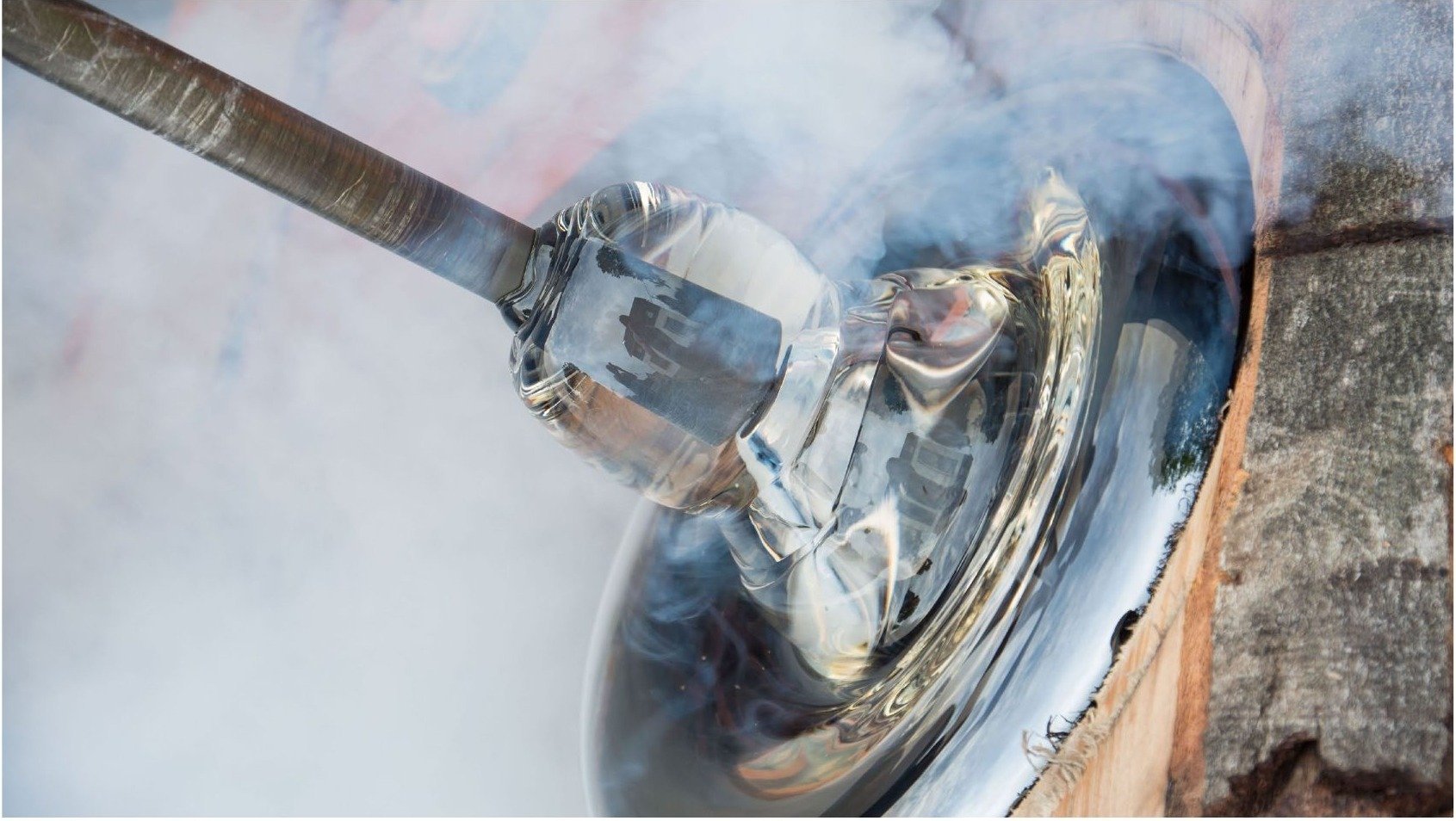
No two gathers of molten glass cool into the same object. Why the small variations in hand-blown glass are not imperfections, but the entire point.
Machine-made glass is a triumph of repetition. Every piece identical, every wall thickness uniform, every surface optically silent. It is an achievement—and in lighting, it is also a limitation, because a room lit through perfectly uniform glass is lit by a material with nothing to say.
Hand-blown glass speaks. Each component begins as a gather of molten glass on the end of a blowpipe, shaped by breath, gravity, and a maker's judgement in a window of a few minutes while the material will still listen. No two gathers cool into the same object. The variations are small—a wall a fraction thicker on one side, a curve that resolves slightly differently, a faint record of movement frozen into the surface—but they are everywhere, and light finds all of them.
What variation does to light
Pass light through a hand-blown component and it refracts unevenly—brighter here, softer there, with slow gradients a machine could not produce and would not tolerate. Multiply that by forty or sixty components in a single composition and the result is a quality of light that reads as alive: shifting as you move through the room, different at noon and at midnight, never quite the same twice.
This is why the material is chosen for pieces meant to hold a room. Uniform glass produces illumination. Hand-blown glass produces atmosphere.
Reading a finish
Finish decides how much of the glass's character is on display. Clear crystal shows everything—every gradient and movement—and produces the liveliest sparkle. Sandblasted and opal surfaces scatter light into a calm, even glow, trading sparkle for softness; they suit rooms where the fixture should recede into atmosphere. Coloured glass—cognac, amber, smoke—warms every ray that passes through it and shifts the entire room's palette toward evening.
None of these is the correct choice. The correct choice is the one made standing in the room, or as close to it as a sample in daylight can come—which is why an atelier sends material samples before anything is made.
Living with it
A hand-made glass composition asks very little. Dust it as you would any fine object; clean it, rarely, with nothing more aggressive than a soft cloth. What it gives back compounds: the small asymmetries that identify it as a made thing are the same qualities that keep it interesting a decade in. Perfect objects exhaust their novelty. Living ones do not.